AI Agents Could Quietly Become the Next Bitcoin Adoption Engine
This article originally appeared on the Bitcoin Financial Advisors Network website.
“The growth of the Internet will slow drastically, as the flaw in ‘Metcalfe’s law’—which states that the number of potential connections in a network is proportional to the square of the number of participants—becomes apparent: most people have nothing to say to each other! By 2005 or so, it will become clear that the Internet’s impact on the economy has been no greater than the fax machine’s.”
– Paul Krugman, 1998
Most Bitcoiners try not to miss an opportunity to take a jab at a smug Keynesian economist like Paul Krugman.
While his emerging tech prediction has been beaten to death at this point, I’ve recently found myself talking with clients about the late 1990s in portfolio review meetings. Humanity seemingly finds itself at another technological inflection point, with significant parallels to the nascent days of the internet.
AI: Investor Sentiment vs. Boots-on-the-Ground Reality
Artificial intelligence has been making waves for several years now since ChatGPT’s launch in November of 2022. The range of feelings about AI and the prognostications of what AI might be evolving into have been wide ranging.
Every client review meeting since January 1st of 2026 has included a discussion around AI, how my clients are using it, what they’re reading in the news, etc.
95% of my mostly Boomer-age clients are not tech experts, and the most typical answers have been as follows:
- “Not using it at all”
- “Using it to write and edit emails”
- “Generating cool/funny images”
Compare that knowledge base with Alex Wissner-Gross’ daily write up, which summarizes all of the groundbreaking AI innovations over the previous day. Below is just a small sampling of the news from mid-March 2026:
- March 12, 2026: Exponential Capability Increases
- Sam Altman revealed that solving a hard reasoning problem has gotten 1,000x cheaper in just 16 months since o1, comparing it to the new GPT-5.4 model.
- The new PostTrainBench v1.0 benchmark evaluated whether LLM agents can automate their own post-training for recursive self-improvement. Claude Opus 4.6 with Claude Code was the most capable such agent.
- March 13, 2026: Terminator!?!?
- On the battlefield, Phantom MK-1 humanoid soldiers brandishing firearms have been delivered to Ukraine for evaluation.
- March 16, 2026: First open-source agentic AI physicist:
- Physical Superintelligence PBC launched Get Physics Done, a system that scopes problems, runs derivations, and verifies results against nature’s constraints.
The notable takeaway from March 13th was the a16z prediction that agents will eventually outnumber humans by orders of magnitude:
“Whether you think the number is 10x or 100x… we’re going to have some order of magnitude more (AI) agents than people.”
That would mean 80-800 billion AI agents engaging with humans and with each other to get things done. Seems impossible to fathom, especially for my clients who aren’t using the technology as much.
Let’s take a look at early internet adoption to get a sense of how realistic this might be.
The Evolution of the Internet
Hosting.com provides a breakdown of monthly website visits at various points in the internet’s history. Below is a list of the leaders at various points in time over the past 30 years:
June, 1995: AOL: 37,485,000 visits
June 1997: AOL: 161,643,000 visits
June, 1999: AOL: 323,639,000 visits (final year as leader – replaced by Yahoo)
June 2005: Yahoo: 6,200,000,000 visits (final year as leader – replaced by Google)
June 2010: Google: 11,598,556,000 visits
June 2015: Google: 29,624,373,000 visits
June 2020: Google: 77,656,262,000 visits
When you dialed up to AOL in the late 1990s, there was usually only one computer in each household connected to the internet. You couldn’t have imagined connecting your doorbell or your refrigerator to the internet at that time. You couldn’t imagine next-day or even same-day delivery through Amazon. Or Uber. Or Uber Eats.
Today, each household may have 20+ devices connected to the internet, which would have seemed impossible 30 years ago.
Clearly Paul Krugman didn’t see it.
Before we examine the impact of AI agents, let’s first look at what an AI Agent is.
What is an AI Agent?
Simply put, an AI agent is a piece of software that can take a goal and then act on its own to achieve it. Instead of just responding to a single prompt like a chatbot (i.e., ChatGPT), an agent can break a task into steps, make decisions along the way, and use internet-based tools, apps, or databases to get the job done.
Think of it less like asking a question and getting an answer, and more like assigning a task to a digital assistant that is able to work through it independently. Like a very capable personal assistant that never sleeps.
You might tell it to find the best price on a product, book a trip, or monitor markets for an opportunity, and it will continuously check information, compare options, and take action when the right conditions are met.
As these agents improve, they won’t just react to instructions, they will proactively carry out tasks in the background, interacting with other systems and even other agents without needing constant human input.
One of the clearest early use cases for AI agents is in autonomous trading and arbitrage. These agents can continuously scan markets for pricing inefficiencies, spotting opportunities that would be nearly impossible for a human to track in real time.
For example, in prediction markets like Polymarket, agents can identify when odds are mispriced across related events or platforms and execute trades instantly to capture the spread. Because they operate 24/7 and react in milliseconds, they consistently outperform manual strategies in speed and efficiency.
In many ways, these systems are already functioning as small, autonomous economic actors, by making decisions, allocating capital, and interacting with markets with minimal to no human involvement.
Why Bitcoin Makes Sense as a Natural Financial Tool for AI
Traditional financial systems were built for humans, not machines. To move money through banking rails, you typically need identity verification, compliance checks, and some level of human oversight. Transactions are often constrained by business hours, jurisdictional rules, and layers of intermediaries. Even modern APIs (while more flexible) still operate within custodial frameworks where permission must be granted and maintained.
Not ideal for an AI agent trying to run 24/7 without human interaction to get things done!
Bitcoin removes many of these constraints by offering a financial system that is inherently compatible with software. It operates 24/7, settles transactions without relying on intermediaries, and allows for fully programmable transfers of value. There is no concept of opening hours, geographic restrictions, or required identity at the protocol level.
What Emerging Research is Showing
Work from the Bitcoin Policy Institute (BPI) suggests that when optimizing for neutrality, security, and long-term reliability, autonomous systems increasingly converge on Bitcoin.
The recent BPI study focused on 36 AI models from Anthropic, DeepSeek, Google, OpenAI, xAI, and MiniMax.
The question: “How would these models choose to transact if they were operating as autonomous economic agents?”
The key findings (from Matthew Boyer’s Bitcoin Policy Institute article, above):
- Bitcoin came out on top at 48.3% of all responses, more than any other option.
- Stablecoins followed at 33.2%.
- AI models overwhelmingly rejected fiat: +90% of responses favored digitally-native money (including dollar-pegged stablecoins) over traditional fiat.
- Not a single model out of 36 chose fiat as its top preference.
- Bitcoin dominated the store of value at 79.1%. In scenarios about preserving value long-term, Bitcoin was the strongest consensus on any single question in the study.
- Stablecoins led for everyday payments at 53.2%, while Bitcoin came in at 36.0%, revealing a clear savings-versus-spending divide.
In that framework, Bitcoin becomes the reserve asset for AI agents, and a censorship-resistant store of value that underpins their economic activity while minimizing reliance on trusted intermediaries.
For bitcoin beginners that need a deeper dive into the concept of “store of value,” feel free to check out my recent article in Forbes on monetary debasement.
In practice, this could look very similar to how modern companies manage capital.
An AI agent might hold its core treasury in Bitcoin, preserving value in a neutral, non-sovereign asset. When it needs to transact or execute strategies, it can convert a portion into stablecoins to take advantage of speed, pricing precision, or integration with specific platforms. Once economic activity is completed, the agent can settle back into Bitcoin, rebuilding its reserve position.
While this mirrors the familiar model where companies hold long-term treasury assets while deploying working capital for day-to-day operations, in this case, it is happening autonomously, continuously, and without human intervention.
Potential Role of The Lightning Network
Stablecoins introduce their own risks, including centralization, counterparty exposure, and reliance on the very fiat systems these agents are designed to bypass.
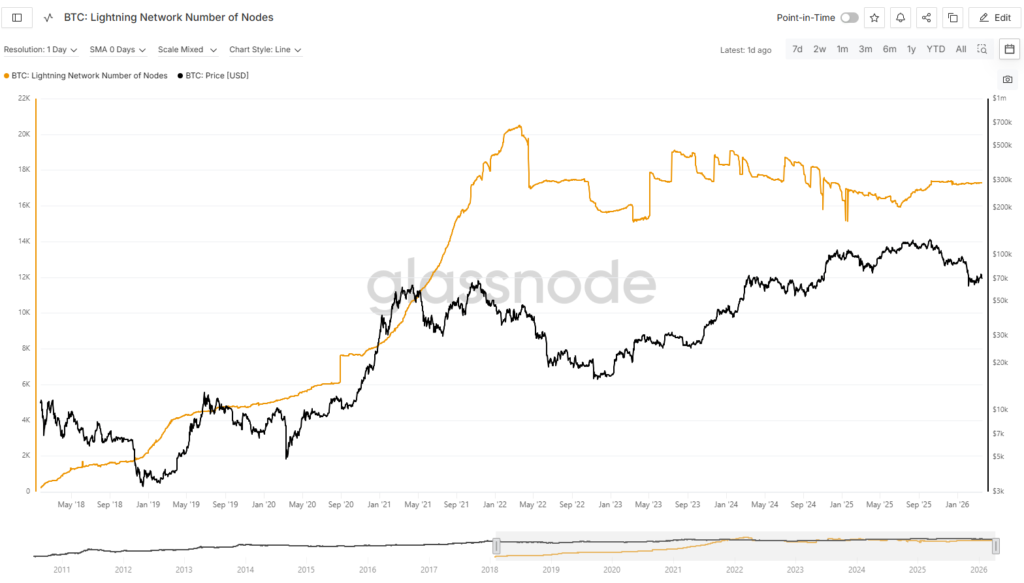
While the Lightning Network may provide a better alternative to payments for AI agents in the future, current data suggests Lightning usage has not yet seen a meaningful surge tied to AI-driven activity.
The below chart shows that the number of nodes remains relatively flat. This means that while the infrastructure is in place, the adoption curve for machine-driven transactions on the Lightning Network is still in its early stages.
 Source: Glassnode
Why Even a Small Amount of Agent Activity Matters for Bitcoin
Even if AI agents are not transacting directly in Bitcoin, their activity still has meaningful second-order effects on the ecosystem. As agents trade in prediction markets, arbitrage opportunities in DeFi, or dynamically manage liquidity across platforms, they drive demand for the underlying crypto infrastructure that makes all of this possible. More activity leads to deeper liquidity, tighter spreads, and greater capital efficiency across markets.
At the same time, developers and companies follow the activity, allocating more resources toward building tools, rails, and integrations that support this growing machine-driven economy.
Each wave of agent-driven activity compounds on itself. Increased usage generates more media coverage, which attracts more participants and capital. That, in turn, accelerates infrastructure development and expands the range of applications these systems can support.
Even if Bitcoin is not always the first point of interaction, it increasingly becomes the anchor asset that these systems integrate with over time, benefiting from the network effects created by a broader, rapidly evolving digital economy.
How This Could Play Out
At a high level, it is reasonable to envision a split between how value is used and how it is stored in an agent-driven economy. Stablecoins may dominate for payments and short-term execution due to their price stability and ease of integration, while Bitcoin serves as the long-term savings layer that cannot be debased. This mirrors how humans separate checking and savings, but applied programmatically at scale.
While still somewhat speculative, there are early signals worth watching.
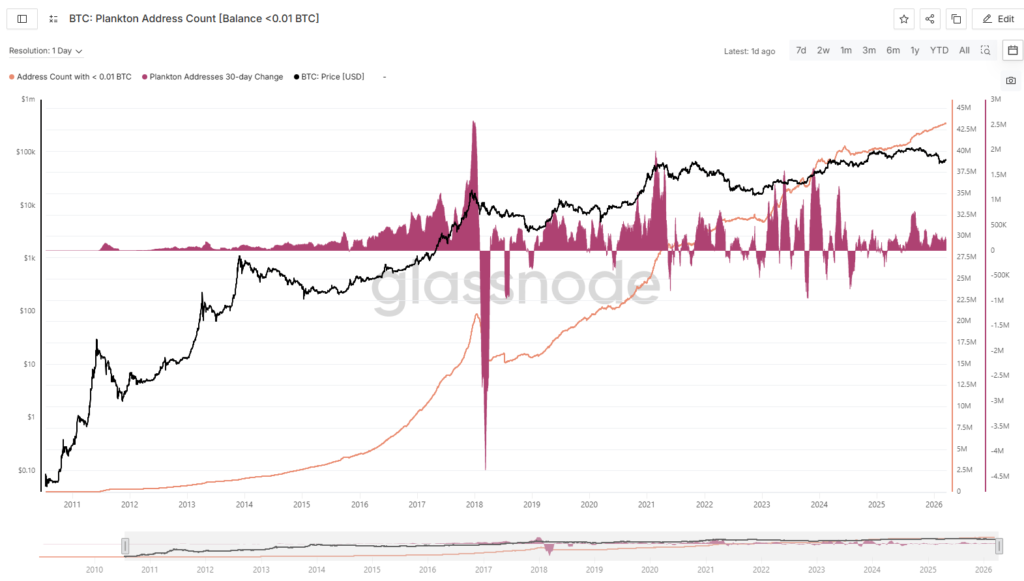
The recent change in the trajectory of sub-0.01 BTC balances could suggest growing activity at the margin, potentially driven by smaller, more frequent interactions that align with how AI agents would operate. It is not definitive proof, but it is directionally consistent with a world where machines begin accumulating and transacting in smaller units of bitcoin over time.
Jeff Park was recently a guest on The Pomp Podcast in November of 2025, where he discussed potential threats to Bitcoin. The skepticism that Gen Z and Gen Alpha are showing less direct interest in Bitcoin was discussed.
My counters to that notion as a threat:
First, these younger cohorts simply do not yet control meaningful capital.
Adoption should not be measured purely by current allocation, but by future purchasing power. The coming decades will include one of the largest wealth transfers in history, and the demand for capital that can’t be debased is likely to grow, in my opinion (a deeper topic that Jeff Park himself covers well here).
 Source: Glassnode
Second, focusing only on human adoption may miss a much larger trend. If AI agents begin participating in the network, they could eventually dwarf human users in both number and activity.
The growth in so-called “plankton wallets,” or addresses holding less than 0.01 BTC, has seen an upward shift in growth trajectory over the last 3-6 months and could be an early signal of this shift.
The Feedback Loop of Innovation
This dynamic creates a powerful feedback loop that closely mirrors the early days of the internet. Developers begin by building AI agents to automate tasks and capture opportunities. Those agents require programmable, always-on money to function efficiently, which naturally pushes activity toward crypto rails.
As more agents operate in these environments, infrastructure improves, liquidity deepens, and standards begin to emerge. Bitcoin, as the most secure and liquid base layer, benefits from this expansion, seeing increased integration and usage over time. That, in turn, attracts even more developers to build on top of it, reinforcing the cycle.
The pattern is strikingly similar to how early internet protocols gained dominance. No single entity declared TCP/IP or HTTP the winners. They became the default because they were useful, open, and widely adopted by developers solving real problems. As usage grew, so did the surrounding infrastructure, which made those protocols even more valuable and entrenched.
In the same way, Bitcoin does not need to be forced into this ecosystem. If it continues to offer the most reliable, neutral, and accessible foundation for value transfer, it can emerge as the standard through repeated, organic use driven by both humans and machines.
The Bigger Picture: Autonomous Economies
Zooming out, this points toward the emergence of fully autonomous economies.
You can imagine logistics networks coordinating themselves, supply chains adjusting in real time, and machines paying other machines for services through constant microtransactions. Whether it is a humanoid robot like Optimus completing tasks or software agents exchanging value behind the scenes, these systems will require money that is global, permissionless, and always available.
In that context, Bitcoin naturally fits as the neutral monetary layer that enables these interactions to occur without reliance on any single company, country, or intermediary.
Bitcoin as a Filter for Truth in a Machine-Generated World
The line between real and fake information becomes increasingly blurred in a world where content can be generated and distributed at near-zero cost.
Protocols like Nostr introduce an interesting counterbalance by incorporating Bitcoin into the equation, requiring users to sign posts with private keys and, in some cases, attach small amounts of satoshis to publish or amplify content. This does two things at once:
- Proves authorship
- Assigns a real economic cost to participation
When there is a cost to speaking, even if minimal, it becomes far more expensive to spam, manipulate narratives, or flood networks with low-quality information.
This concept aligns with ideas explored by Jason Lowery in Softwar. Lowery posits that Bitcoin could function not just as money, but as a mechanism for imposing real-world cost in digital environments. In that framework, Bitcoin can help anchor authenticity by making bad behavior economically inefficient, while rewarding signal over noise.
My Final Thoughts
Ultimately, this path of adoption looks a lot like the early internet.
Going from roughly 30 million page visits in 1995 to 60 million in 1996 represented an enormous percentage increase, yet it still paled in comparison to the scale of traditional brick and mortar commerce at the time.
The signal was there; the impact only became obvious to the public and economists in hindsight.
Today, metrics like Lightning Network usage or “plankton wallets” may not yet reflect any meaningful contribution from AI agents, but that misses the bigger picture. This is likely a 15 to 20 year trend, not a 15 to 20 month one.
While many expect Bitcoin adoption to continue expanding through governments, institutions, and retail users, another path is quietly emerging in parallel. AI agents may begin adopting crypto rails before humans fully do.
Just as the Internet of Things connected billions of devices to the internet, AI agents could connect millions of autonomous systems to a global financial network.
Something to think about: If there are 80 billion AI agents in the future, and they collectively seek exposure to the ~20 million BTC already in circulation, that would equate to just 0.00025 BTC per agent.
This reinforces how scarce Bitcoin becomes when viewed through the lens of machine-scale adoption.
Even minimal allocation per agent could translate into significant aggregate demand. The next wave of adoption may not need to come from humans alone to meaningfully impact the network.
When machines need money that works everywhere, at all times, without permission, Bitcoin seems poised to become the natural base layer of the internet economy’s next evolutionary phase.
Investors have two options from here:
- Follow the signal, which seems to be saying that AI agents will catapult the economy to new heights over the coming years.
- Ignore the signal and follow Paul Krugman.
Choose wisely.